Brazil is in the middle of a wave pool boom. Billions of reais are being invested in the market.
The first generation emerged inside gated residential communities like Praia da Grama and Fazenda Boa Vista, proving that a world-class artificial wave can be an exceptionally strong anchor for high-end real estate. It was a lower-risk model with a shorter path to returns — one that made sense at a moment when the market still had real uncertainty about the technology's reliability and acceptance. Two other models followed: fractional ownership (Surfland, in Garopaba), selling fractions of hotel apartments — 25 fractions per unit, each with the right to two weeks a year and a deed in the buyer's name — and, more recently, private clubs (Beyond The Club, São Paulo Surf Club, and Brasil Surfe Club), selling expensive memberships into an exclusive community.
Each model taught the market something:
- Residential developments validated demand for wave pools and buyers' willingness to pay a significant premium for an exclusive product in the luxury market.
- Fractional ownership showed demand for a mid-priced real estate product, but also exposed the limits of that demand in small, seasonal destinations. In the process, Surfland also showed that a wave pool open to the public — which is what Surfland has been doing temporarily, while the resort's construction is finished — can run at 70% occupancy even far from major cities.
- Private clubs demonstrated an extraordinary perceived value even with no real estate attached: families paying R$800,000–R$1,000,000 for memberships, on top of significant monthly dues, for access to the most hyped piece of sporting equipment around.
Behind the headlines sits a structural truth about the wave pool business model: the pool is the star asset — and it has a capacity bottleneck.
| Residential | Fractional Ownership | Club | Public |
|---|---|---|---|
| Buyer purchases a lot, house, or apartment and can use the pool as shared community infrastructure. | Buyer purchases a fraction of a hotel apartment, with a registered deed and usage rights (typically 1–2 weeks a year), and can use the pool during their stay. | Member purchases a membership granting access to the club's facilities, including the pool — restricted to members only. | Customers can buy individual surf sessions at any time, with no obligation to buy real estate or a club membership. |
The Capacity Bottleneck Nobody Can Ignore
Even the best wave pools can only host a limited number of surfers at once. In the most common pools, weekly capacity on the main wave — the one that attracts everyone from weekend surfers to world champions — runs around 1,500–5,000 sessions per week (not counting beginner capacity). Only Surf Lakes, which doesn't yet have a pool in Brazil, delivers more. These are the limits of the technology itself.
| Perfect Swell | Endless Surf / Wavegarden | Surf Lakes | |
|---|---|---|---|
| Sessions per hour | 12 | 40 | 160 |
| Sessions per week (18h/day, 7 days/week) | 1,512 | 5,040 | 20,160 |
1 session = one hour of surfing for one surfer.
Market research tells us most surfers want to surf 2–4 hours a week. For an Endless Surf or Wavegarden pool, that works out to around 1,600 regular customers. Praia da Grama, with roughly 500 residences (and perhaps an average of 3 surfers per household), lands at a reasonably sensible number — though demand there is likely concentrated much more heavily on weekends.
Now put that in context against some already-announced clubs. Brasil Surfe Clube talks about selling 3,000 memberships on an Endless Surf pool with capacity for 40 sessions an hour. Beyond The Club states on its own website 3,000 family memberships, on a Wavegarden pool with the same capacity. Because these are family memberships, there may well be more than one surfer per membership. But assume, for a moment, just one surfer per membership: that works out to roughly 1.5 hours per surfer per week. Knowing that many members want to surf 2–4 times a week, we should expect frustration with availability, near-constant crowding, and real difficulty booking a preferred time slot.
Imagine paying R$800,000 for a membership, plus R$2,000 a month in dues. Over ten years, total outlay tops R$1 million. Assuming you only manage that average of 1.5 hours a week — well below what you'd want — each session costs roughly R$1,333, before even counting the opportunity cost of capital locked up in the club. Add the difficulty of booking preferred time slots because of overcrowding, and the friction of fitting sessions around work, school, and family. It's a reliable recipe for frustrating a high-net-worth member who can't get the access to surfing that they paid handsomely for and expected to have.
A wave pool is a spectacular asset. But sell too much access through memberships, and you're not selling exclusivity — you're selling a queue.

Clubs often argue that not every member surfs. That may be true on day one. But in a family club built around the wave, a meaningful share of children and adults are going to learn. Within weeks or months, many move from the beginner zone to the main wave. The share of memberships with no active surfer falls, and demand concentrates on the most desirable time slots.
Factor in family memberships — often with 2–3 active surfers — and you quickly reach 6,000–8,000 surfers, sharply compounding an already significant problem. In these scenarios, members may not even get a full hour of surfing a week.
There's a second problem with the club model when the intent is to anchor surrounding real estate development: while it may boost nearby property values at first, once memberships sell out and buyers of new nearby homes have no path to club access, that real estate premium disappears.
Why Do Some Private Developments Feel Dead?

Another challenge for residential projects and closed clubs is the vitality of the place itself. At public-access destinations, a substantial share of visitors aren't surfers at all. They come to eat, to watch, to take lessons, to work from the café, to attend events, or simply to enjoy a "day at the beach." Surfers turn the place into a gathering point and keep coming back even when they're not in the water. The place becomes a tribal, touristic hub.
Replace that public flow with a small number of members in a condominium or club — one that hasn't overcrowded the pool and has no meaningful volume of other activity — and you get beautiful water and perfect waves… surrounded by an empty beach, silent restaurants, and long dead stretches. Surfing is electric for whoever is in the water; outside of it, the place can feel empty and soulless.
This isn't a cosmetic detail — it sits at the heart of the masterplan. Is your pool a single-purpose jewel that shines for a small group and then "switches off"? Or does it anchor a mixed-use ecosystem that breathes and stays alive all day, into the night? A beautiful but soulless destination delivers only a fraction of the potential for community-building and real estate value creation. This pattern is easy to spot in residential projects around São Paulo: incredible waves and beautiful landscapes, but little reason to stay once you're out of the water.
The Public Model: Demand, Pricing, and the Business Case
So what's the future of wave pools in Brazil? The next, inevitable iteration in the country's biggest cities is the public-access model. Its viability is no longer a question of faith — it's proven by a track record of successful projects around the world.
| Location | Performance Highlights |
|---|---|
| O2 Surftown Munich, Germany | Located 40 minutes from a city of 1.4 million people, more than a thousand kilometers from a coastline with waves. Operates 17 hours a day at near-100% occupancy, with sessions priced between R$550–900. |
| Lost Shore Surf Resort Edinburgh, Scotland | Located in a city of 900,000 people with no strong surf culture, and average temperatures of 3–14°C. Prices of R$360–500 per session; generated £18 million (more than R$120 million) in profit in its first year. |
| URBNSURF Sydney, Australia | Opened in 2024. Operates 17 hours a day at above 90% occupancy, with session prices of R$400–600. |
| Surfland Garopaba, Brazil | Built for resort fraction owners, but running in public mode while the resort's construction is finished. Sessions priced at R$399, with occupancy around 70%, in a city of 34,000 residents that receives 150,000 tourists a year. |
These international examples show a clear pattern: well-operated public parks aren't just financially viable — they become powerful regional destinations. They prove the demand exists, and that the public is willing to pay for quality waves without needing a club membership.

Now look at São Paulo — a city of roughly 400,000 surfers (TGI IBOPE), with no natural beach. The existing projects (Praia da Grama, Fazenda Boa Vista, São Paulo Surf Club, and Beyond The Club), combined, serve fewer than 10,000 surfers. At an average demand of three sessions per surfer per week (per market research), that implies potential demand in the hundreds of thousands of sessions per week — against roughly 5,000 sessions per week of supply from the most common pool technologies. In simple market terms, the gap is enormous.
But what about viability? Does it make sense for investors? Let's look at some numbers:
- Guest sessions at Boa Vista Surf Village cost between R$2,000 and R$2,500, and are restricted to members' guests.
- A hypothetical R$800,000 membership with R$2,000/month in dues, amortized over 20 years, works out to roughly R$820 per hour — before even accounting for the lost return on capital tied up in the membership.
Now apply conservative math to São Paulo. Even though a Boa Vista guest today pays between R$2,000–2,500, and a full ten-year cost-per-hour at Beyond works out above R$1,000/hr, we can model a much lower price for a public park in São Paulo — R$400 per hour per surfer. At 40 sessions/hour and 80% utilization on the peak wave (not counting beginners), that alone implies roughly R$84 million a year in peak-surf revenue. Add lessons, photos, video, equipment rental and retail, food and beverage, sponsorship, events, and more, and gross revenue can climb above R$130 million a year. Against an investment of R$300 million, that points to a five-year payback and an IRR above 20% in a conservative scenario. Match Munich's pricing and occupancy, and that IRR climbs above 30%. Prudent leverage pushes it higher still.
Wrap the pool inside a mixed-use development — hotel, bars and restaurants, retail, live events, coworking, wellness, and more — and the returns keep improving, while also expanding the value of the place and the real estate uplift around it.
A well-planned, well-operated, well-located public facility can generate more than R$2 billion in free cash flow over 20 years — against less than R$500 million for a club selling 3,000 memberships at R$300,000 each (as is the case with Brasil Surfe Club) — without even counting the frustrated members who can't surf as much as they want, or the rapid erosion of the real estate premium once memberships sell out. These are order-of-magnitude, illustrative figures, of course — but they demonstrate the scale of the potential.
Will Clubs, Residential Projects, and Fractional Ownership Still Launch?
Absolutely — and many should. There will continue to be demand for clubs offering exclusivity and guaranteed waves, provided they're sized correctly. For a Wavegarden or Endless Surf pool, a cap of roughly 1,000–1,200 surfing members (counting every surfer within family memberships) should allow enough hours and capacity headroom for most members to surf as much — and generally when — they want. Clubs with a broader offer across sport, leisure, and family can sell standard memberships with access to a beautiful "beach" and the option to buy surf lessons, then layer in 1,000–1,200 surf memberships without creating capacity bottlenecks. Done well, these projects bring generational improvements to the quality of life of members and their surrounding communities.
That said, outside São Paulo, launching a club near an existing public pool will likely limit sales significantly, leading to problems similar to Surfland's in Garopaba, which struggled with insufficient apartment sales volume.
In the same way, ultra-selective residential communities with exclusive pool access — if properly sized to avoid overcrowding — will continue to offer a guaranteed, premium option for the wealthiest buyers. In the right market, they'll work even with public pools nearby.
And with the fractional ownership market firmly on the rise, there's plenty of room for growth in the right locations — year-round tourist destinations in warmer regions — with a correctly sized and priced hotel component, creating outstanding vacation destinations and, in all likelihood, solid real estate returns over time for buyers.
Many families will keep choosing private clubs or condominiums for the exclusivity, the guaranteed capacity (when properly sized), the social fabric, and the convenience — not every home will have a public pool nearby. But the big market, the real opportunity for scale and profitability, is in the public model. A huge number of surfers — and an even larger number of the merely curious, who don't yet see themselves as surfers — will come to fill public parks packed with sport, culture, leisure, and entertainment: alive and vibrant seven days a week.
What Will the New Standard Look Like Going Forward?
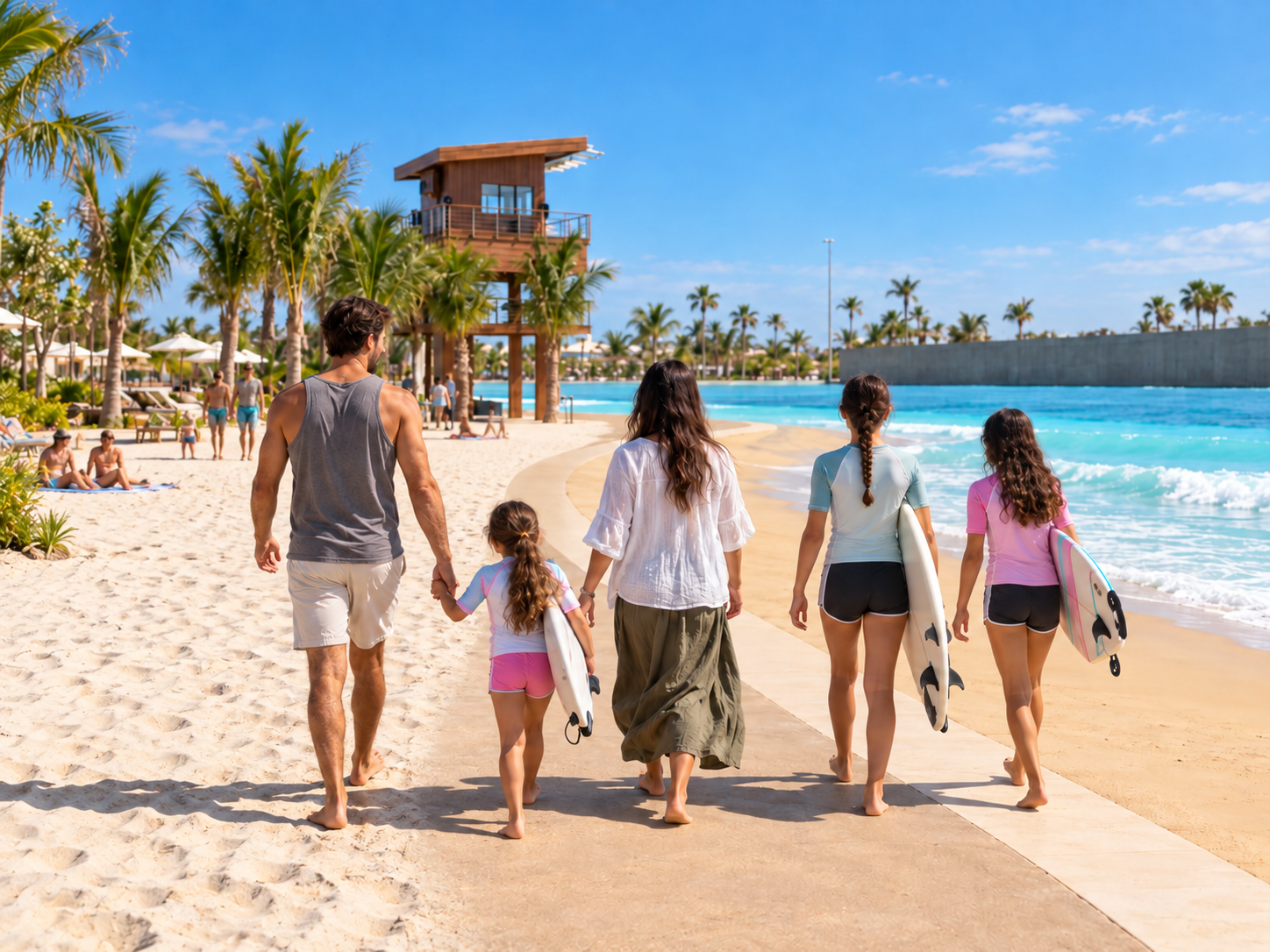
The future isn't just a wave pool — it's a complete destination. The next generation of projects will win not only on price accessibility (R$400–600 an hour, instead of seven-figure buy-ins, opening the market to a far larger pool of surfers), but on the quality of the experience. Think of it as an "urban beach" that pulses with life seven days a week.
This isn't a country club with a wave. It's an integrated ecosystem where the wave is the anchor, but not the whole story. Picture a place where you can play dozens of sports, watch international sporting and cultural events, enjoy activities and attractions for the whole family, relax and play on the beach and in the water, hit the spa, the gym, or a yoga class, eat and drink anywhere from beach kiosks to fine-dining restaurants with stunning water views, shop at boutiques and brand pop-ups, stay overnight in a luxury hotel, and even work from a coworking space with that destination as your everyday backdrop.
This is a place to bring family and friends — many of whom may never set foot in the water, but who'll still feel part of the energy. That's how you create destinations that multiply in value. In a Brazil where big cities lack open public spaces, wave parks can serve a need for the local population that goes far beyond surfing. That's how you build destinations that pulse with life — and businesses that multiply.
None of this means public destinations are risk-free. With multiple revenue lines spanning real estate, commercial operations, and hospitality, public parks are inherently more complex. That makes it critical to bring in a team with real experience developing and operating large-scale sport, entertainment, culture, and leisure complexes — one that has lived through the growing pains elsewhere. Operators also need to stay alert to the fact that, over the medium and long term, operations will be exposed to economic cycles. But building a destination with no equal in its region helps ensure that, even in difficult times, customers keep prioritizing this kind of leisure spend. Reinvesting a healthy share of earnings into upkeep keeps the space feeling new, and a strong pipeline of events and experience innovation gives the public a reason to keep coming back.
One thing is certain: many more wave pools are on the way. And very soon in Brazil, perfect waves will no longer be the exclusive preserve of millionaires. They'll be a new kind of public space. Keep an eye on the horizon — because the biggest wave in the set is still to come.